Lp(a): The “Hidden” Cholesterol Number
We've all had the cholesterol conversation.
Your doctor glances at your lab work, nods thoughtfully, and says something about your cholesterol, and maybe suggests eating a little less cheesecake. You promise to exercise more. Everybody feels productive.
But here's the twist: you can have beautiful cholesterol numbers, run 5Ks on weekends, eat enough kale to frighten a rabbit, and still drop dead from a sudden heart attack.
Meet Lipoprotein(a) – or Lp(a) (pronounced lipoprotein little a). It isn't new. It isn't rare. It just doesn't get invited to most routine cholesterol tests.
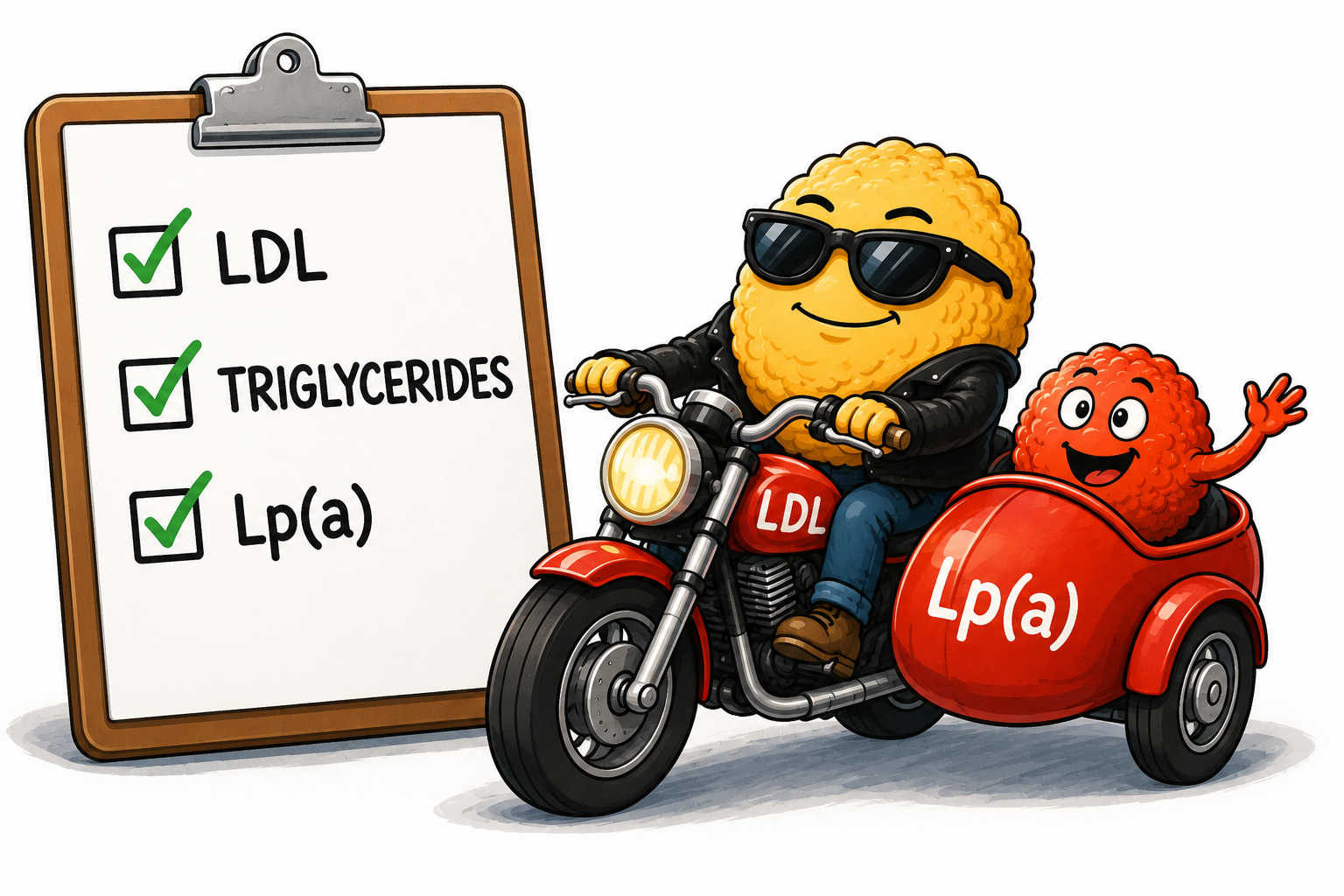
A cartoon of two bad cousins - LDL and Lp(a) - riding the vast roads of a human body
Cholesterol Isn't the Villain
Despite its bad reputation, cholesterol isn't trying to ruin your life. Your body actually needs it to make hormones, build healthy cells, and keep everything running smoothly.
It’s the transportation that is stupid!
Because cholesterol doesn't dissolve in blood, it has to hitch a ride inside tiny particles called lipoproteins.
The one you've probably heard about is LDL – the so-called "bad cholesterol."
Think of LDL as a delivery truck carrying cholesterol through your bloodstream. Too many trucks on the road, and eventually some start crashing into your artery walls. Over time, those little fender-benders turn into plaques that narrow arteries and increase the risk of heart attacks and strokes.
That's bad enough.
Now along comes Lp(a).
Lp(a): LDL's Trouble-Making Cousin
If LDL is the delivery truck, Lp(a) is also a truck ... except bigger and badder, with a grappling hook onto the front bumper.
Scientifically speaking, Lp(a) is an LDL particle with an extra protein attached called apolipoprotein(a).
High Lp(a) has been linked to:
Earlier heart attacks
Earlier strokes
Aortic valve stenosis (hardening and narrowing of one of the heart's major valves)
Three Things Everyone Should Know About Lp(a)
1. It's common.
About 1 in 5 people have elevated Lp(a).
2. You inherited it.
This is one of those rare medical conditions where you really can blame your parents.
3. There is little you can do about it (at least for now).
Unlike regular cholesterol, you can't meaningfully lower Lp(a) with salads, treadmill sessions, or statins.
And the worse part of it all is that a standard cholesterol panel does not measure Lp(a). You can receive a phone call saying, "Everything looks great," while this important genetic risk factor remains completely unknown.
One blood test. One number. A lifetime of useful information.
Because Lp(a) is genetically determined, it stays fairly stable throughout your life. That means most people only need to measure it once.
Who Should Definitely Be Tested?
I believe every adult should measure their Lp(a) level at least once.
It's especially important if:
You have a family history of early heart attacks or strokes.
A close relative has very high cholesterol.
You've had cardiovascular disease despite "normal" cholesterol levels.
You simply want the most complete assessment of your cardiovascular risk.
Knowing your Lp(a) won't predict your future with certainty, but it helps us make smarter decisions today.
Okay...Mine Is High. Now What?
At the moment, we don't have an approved medication that specifically lowers Lp(a), although several very promising gene-silencing therapies are in late-stage clinical trials. That's exciting news, but they're not quite ready for prime time.
Until then, the strategy is straightforward: Lower your LDL aggressively.
If Lp(a) is adding extra risk, we want to remove as much additional cholesterol burden as possible. For many high-risk patients, that means aiming for an LDL below 55 mg/dL.
Plus … fix what you can: blood pressure, blood sugar, smoking, sleep, exercise.
We can't change the genes you inherited, but we can absolutely influence the environment they're living in.
An anti-inflammatory diet, regular physical activity, good sleep, and avoiding tobacco won't erase high Lp(a), but they'll help protect the blood vessels that Lp(a) is trying to irritate.
The Bottom Line
Lp(a) isn't something to lose sleep over. It's something to know. And, one day, control.
Medicine works best when we identify risk before it becomes disease. A simple blood test can uncover a hidden genetic factor that might otherwise go unnoticed for decades.
If your Lp(a) level is normal, wonderful – well, you've just checked an important box.
If it's elevated, we don't panic. Call or text me at 727-252-6060 and let’s strategize.